
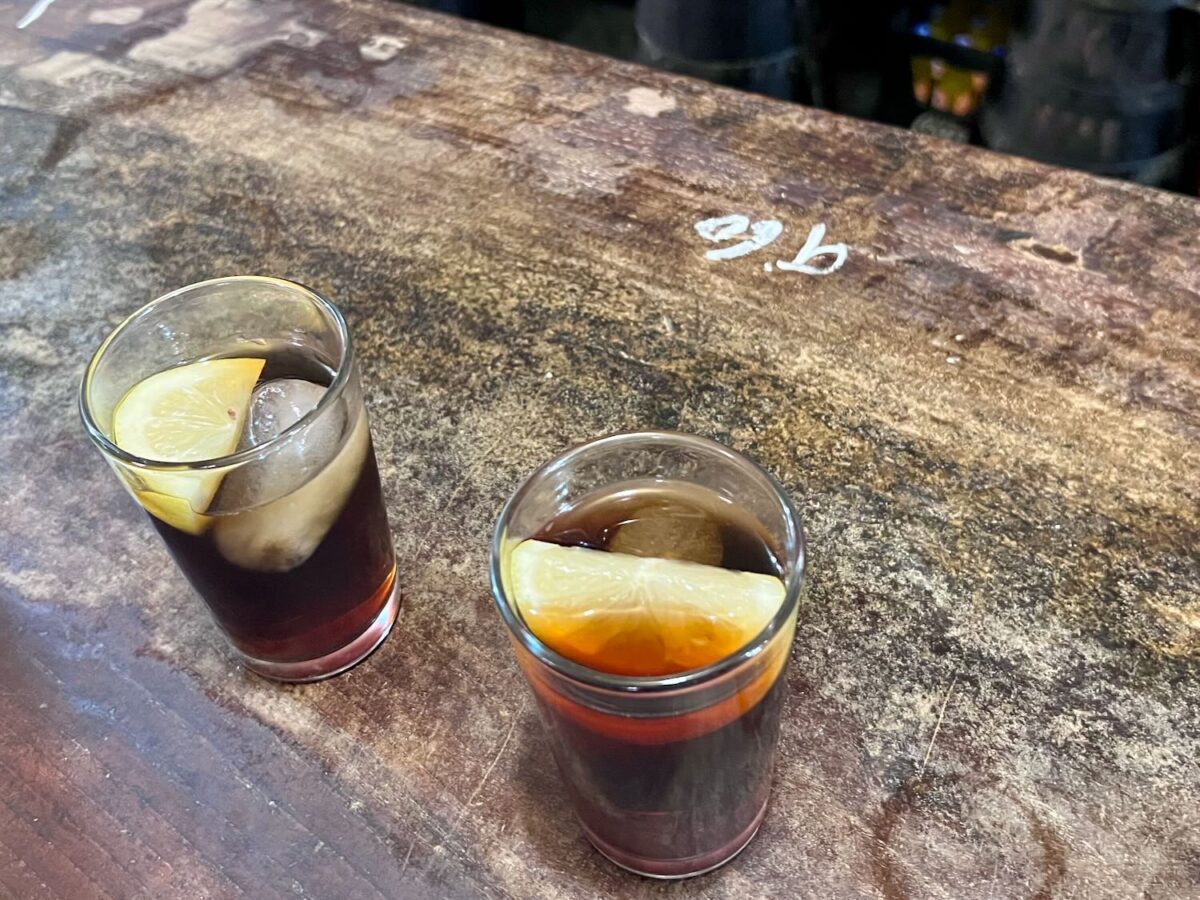
and a chalk mark on the bar
Anyone exploring Málaga by bike soon notices that the past here refuses to stay locked behind museum glass. This is a city built in stone, marble and wood, layer on layer. In the historic El Perchel district, on the west side of the city, we climb onto our e-bikes for a tour through and around the city.
We plunge straight into the heavy traffic. A little later we cross the Puente de la Esperanza. Below us lies the concrete canal of the Guadalmedina, the river that splits the city in two and is dry for most of the year.
“There was an ambitious plan to turn this riverbed into a green city park, exactly as they did with the Turia in Valencia,” says Merle, our guide, when we make our first stop across the dry river.
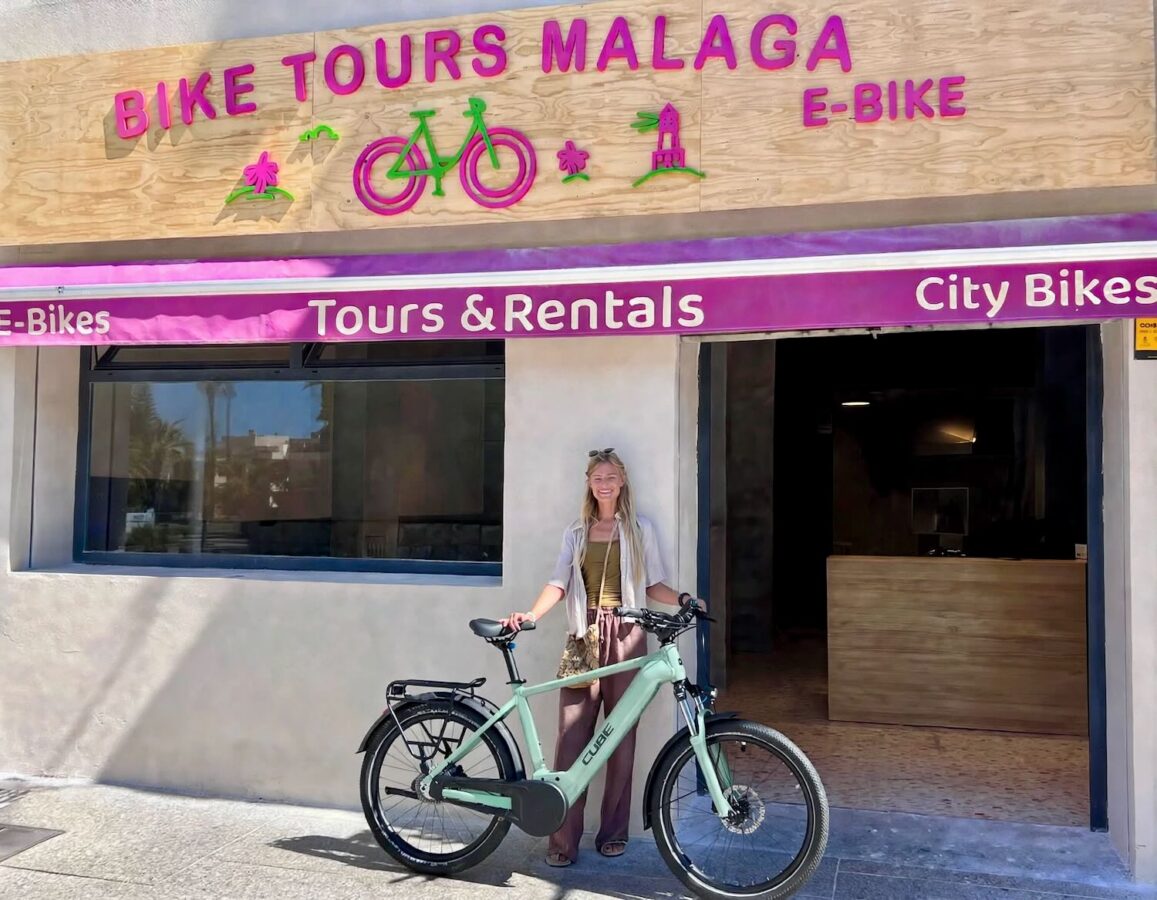
Merle has lived in Coín for more than ten years, a village in the hills just inland from the coast, and knows everyday life in Málaga. “Still, the project was scrapped because of the cost and the risk of flooding when heavy rain falls in the mountains,” she continues. “Now it remains a stark, empty trench of concrete through the middle of the city.”
Legionaries and the Cristo de Mena
A little further on stands the Iglesia de Santo Domingo de Guzmán. In its cool half-darkness rests the wooden figure of the Cristo de la Buena Muerte, better known as the Cristo de Mena. Merle explains that the original seventeenth-century baroque carving by Pedro de Mena was lost in 1931.
What stands there now is a re-creation, carved in 1943 by the sculptor Francisco Palma Burgos from old glass negatives. The figure belongs to the Congregación de Mena, one of the city’s forty-three official brotherhoods, and has a close bond with the soldiers of the Spanish Legion (La Legión Española).
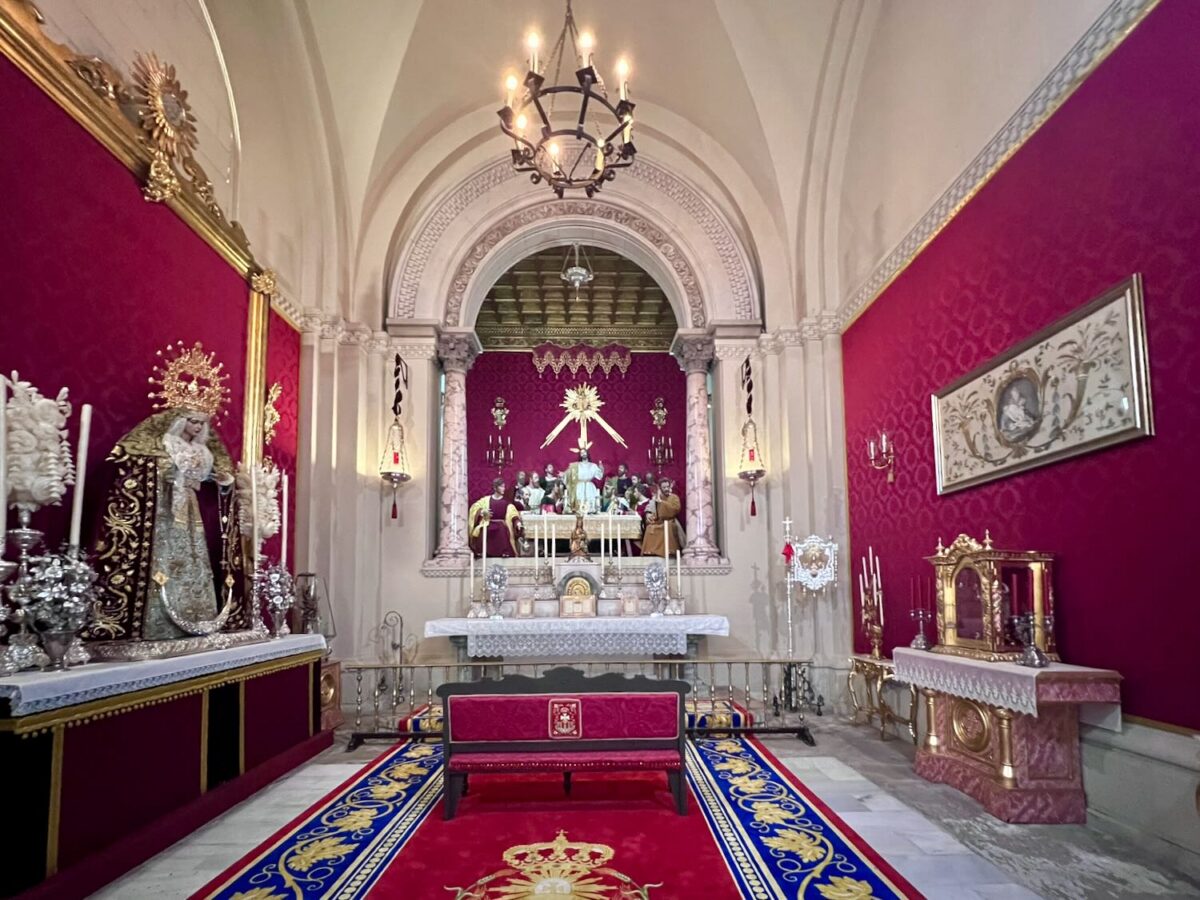
On Maundy Thursday, this square becomes the emotional heart of Málaga, Merle says. “The legionaries arrive by ship in the harbour, step ashore and march through the streets to this spot.”
Singing their anthem, El Novio de la Muerte, they carry the immensely heavy wooden figure out on their shoulders. Outside Semana Santa, the week before Easter, this devotion stays hidden in the nave of the church.
Where the sea once met the land
We ride on, through traffic that looks chaotic to us, towards the Mercado Municipal de Atarazanas. The name recalls the Arabic word for shipyard. In the fourteenth century, under the Moorish Nasrid dynasty, the sea reached as far as this spot and ships were built here.
Of the original Moorish shipyard, only the marble gate with its horseshoe arch on the north side remains. Not until the late nineteenth century did the architect Joaquín de Rucoba build a hall of cast iron and glass around the monument. Where crowds now stroll past the stalls, wooden sailing ships once slid into the water.
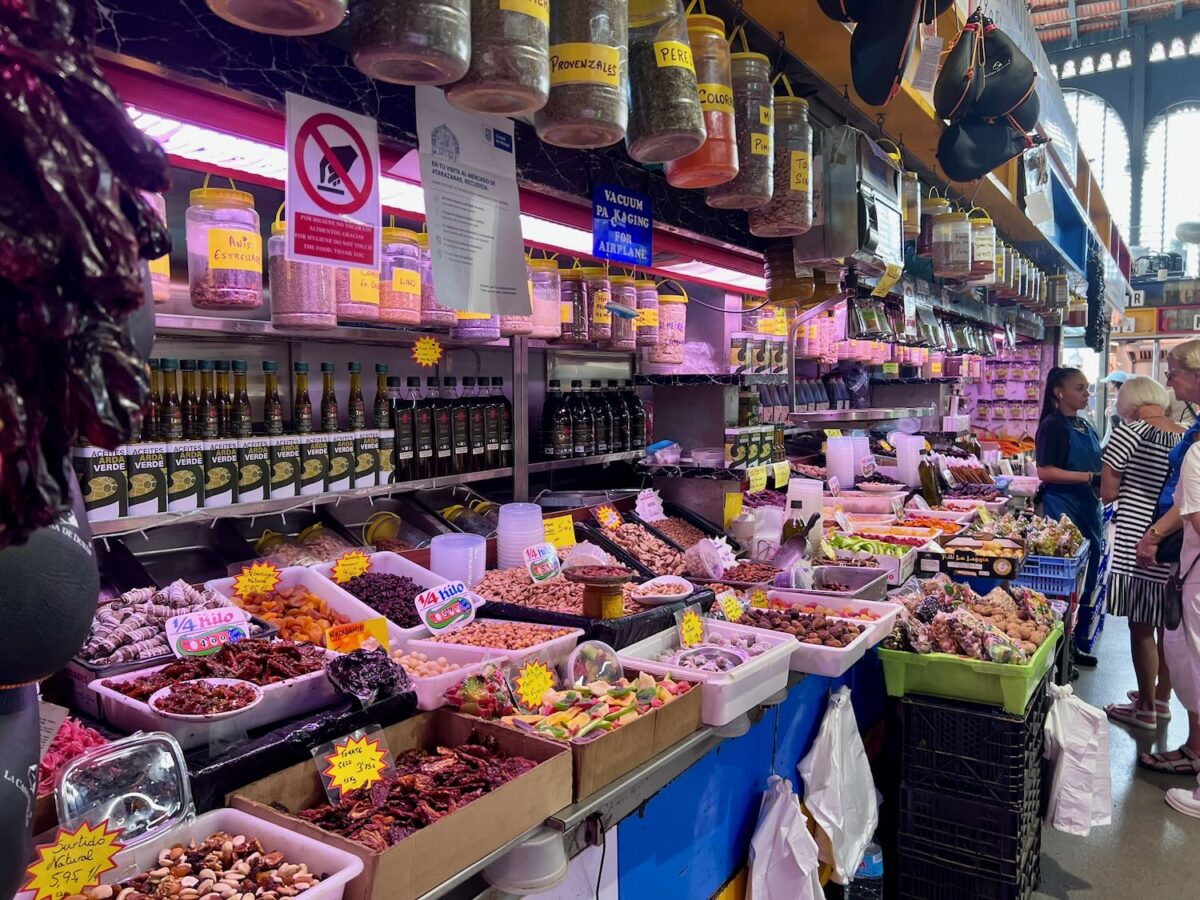
At the fish counter, fresh anchovies (boquerones), squid and prawns lie on ice. We recognise this, but the Spanish names of most of the fish mean nothing to us.
Photography is not appreciated here, I gather as I take out my iPhone. “Hola, señor,” comes from one of the stalls. A man points to a sheet of paper that says in Spanish that taking photographs is not allowed.
Jasmine and the legacy of Emperor Augustus
We continue along the shady Alameda Principal and ride through the Jardines de Pedro Luis Alonso, between the town hall and the park. Architect Fernando Guerrero-Strachan Rosado designed this garden in 1945, with clipped hedges, geometric pools and many kinds of roses.
Among the trees stands the bronze statue of El Biznaguero, cast by Jaime Fernández Pimentel. It shows the traditional street vendor of biznagas: small posies of unopened white jasmine buds, pinned onto the dried stem of a wild thistle before evening. In the cool of the night the buds open and spread their sweet scent through the streets.
Alcazaba and Teatro Romano
Then the climb begins. Put the assistance in a higher setting and use a low gear, Merle advises. That turns out to be useful advice, because we have to tackle a fairly steep slope.
At the foot of the hill rises the Alcazaba, the eleventh-century Islamic fortress of the Hammudid dynasty. Within the double ring of defensive walls and watchtowers lie courtyards with orange trees, fountains and horseshoe arches.
Directly below these Moorish walls rest the stone tiers of the Teatro Romano, the Roman theatre from the time of Emperor Augustus.
Climb to the Gibralfaro
Soon we are far above the city. On this side of Gibralfaro Hill we look out over the modern districts of Málaga with their many tower blocks. On the other side we look out over the harbour and the sea.
Tucked between modern buildings and not far from the lighthouse lies the Plaza de Toros de La Malagueta, a polygonal structure from 1876, built of reddish-brown brick with Neo-Mudéjar arches. Harsh sunlight burns on the sand in the middle of the arena.
Through binoculars, we see the empty circle. The ring measures exactly fifty-two metres across, Merle says. At this hour of the afternoon, nothing moves down there in the depths. “When the arena fills up, everything changes here,” she says, pointing down.
“A few times I have been to a corrida, the bullfight. You never forget the contrast between the festive brass of the orchestra and the raw reality of the bull being dragged out of the arena in a trail of blood.”
Along the quay to La Farola
Along a winding road we roll down to the shoreline at a good speed. Where the harbour was long closed off, the Muelle Uno boulevard and the Palmeral de las Sorpresas promenade now lie.
A white canopy gives shade against the burning afternoon sun, while superyachts glitter in the harsh light at the IGY Málaga Marina. In contrast with the dazzling white of the boats stands El CUBE, the coloured glass cube of the Centre Pompidou Málaga.
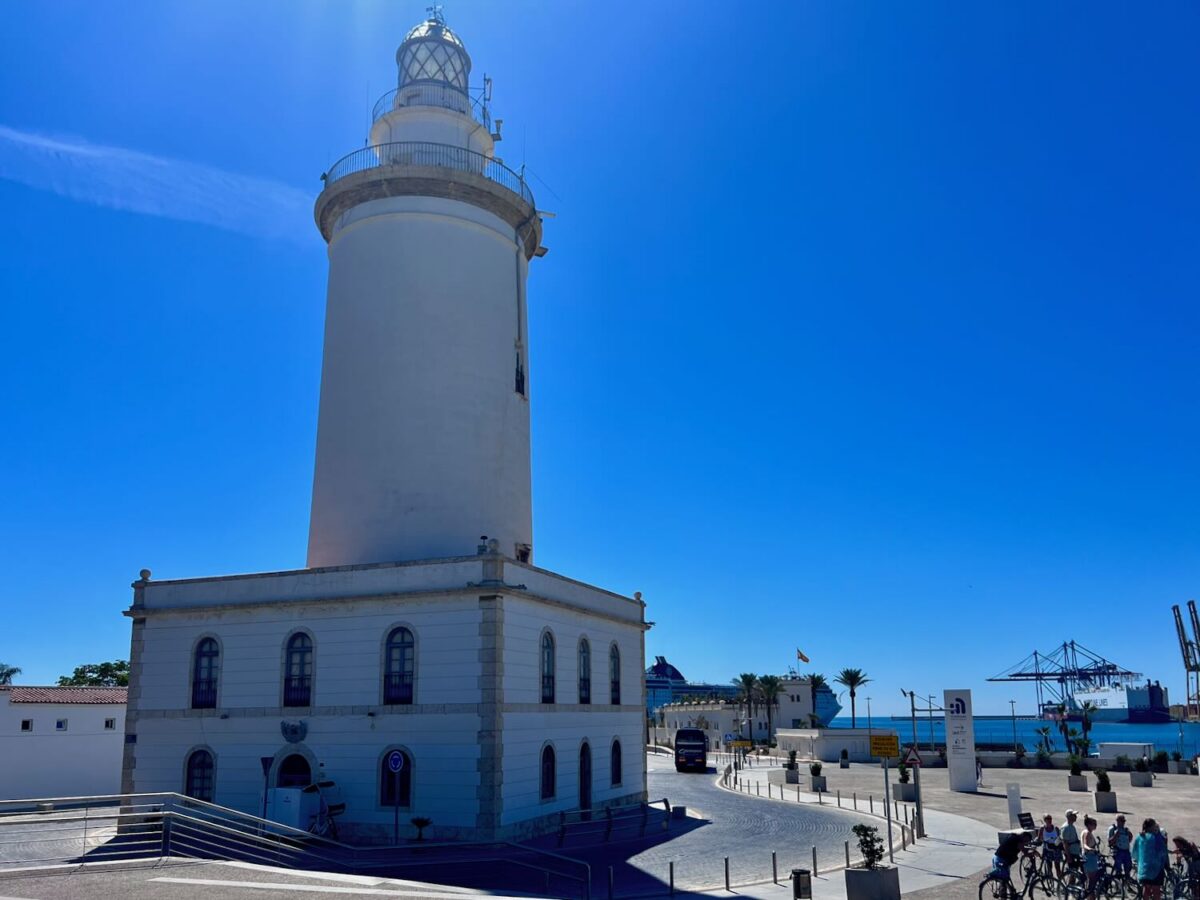
At the end of the pier stands La Farola. The whitewashed lighthouse of 1817 has a striking name. Where Spanish usually calls a lighthouse by the masculine el faro, the people of Málaga use the feminine form.
The thirty-three-metre stone tower still flashes three white beams of light across the water every twenty seconds, visible from more than forty kilometres off the coast.
Finishing with chalk on the bar
After returning the e-bikes to the starting point and saying goodbye to our guide, we walk back on our own towards the Alameda Principal. Our bike tour is over, but we leave Málaga only after a visit to the Antigua Casa de Guardia.
Málaga’s oldest tavern was founded in 1840 by D. José de Guardia. There are no tables or chairs; everyone stands at the long wooden bar. Behind the counter, oak casks are stacked high, full of traditional fortified wines such as Moscatel, Pajarete and Pedro Ximénez.
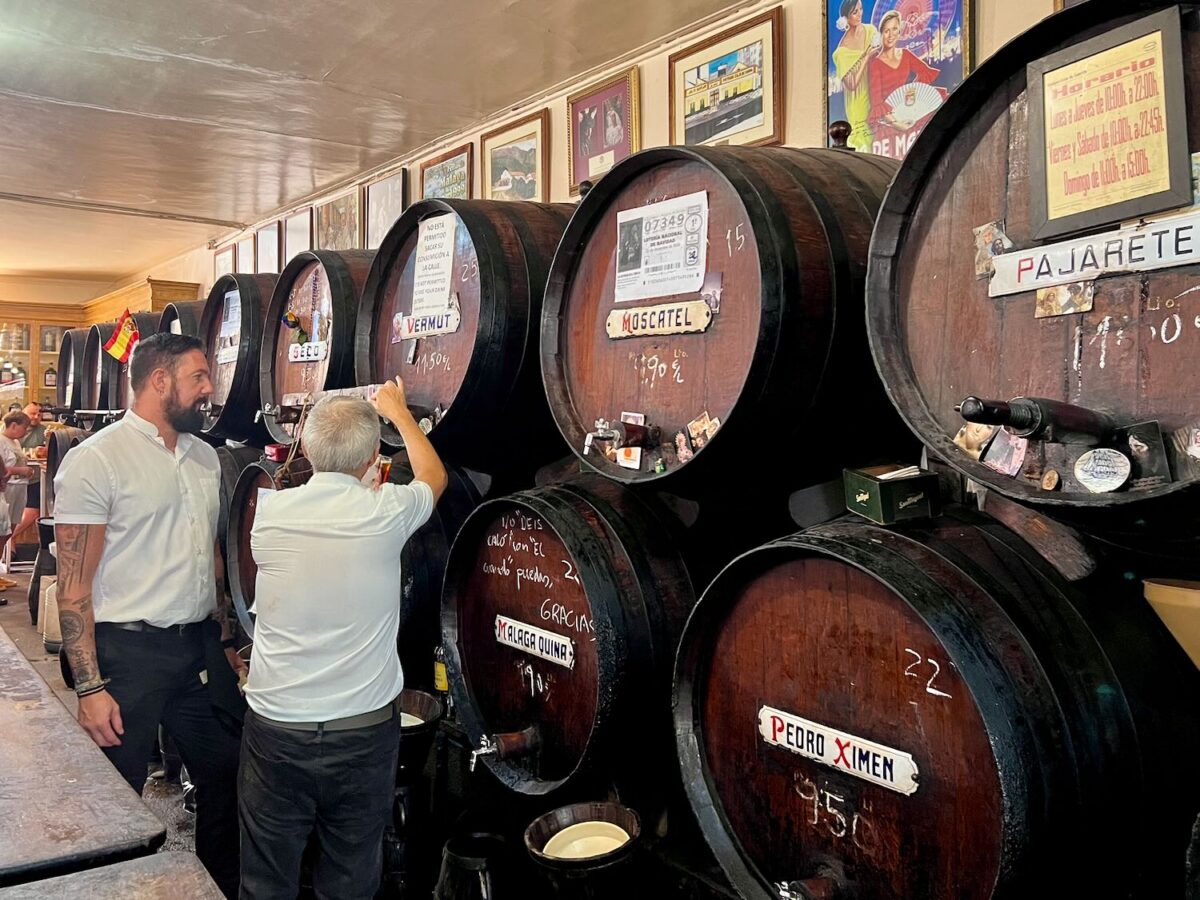
We order glasses of vermouth. The waiter draws them straight from the cask. When he has set our order on the bar, he takes a small piece of white chalk, leans forward and notes the amount on the dark wood. When the glasses are empty and we want to pay, he adds up the amounts, takes a damp cloth and wipes the chalk away.
As fleeting as those white strokes on the wood, so solid stand the stones and the stories of this city. Málaga does not let itself be caught in a single snapshot. It remains a city that balances the dust of the arena, the devotion of the Spanish Legion and the taste of vermouth matured in oak.
Practical information
- Plaza de Toros de La Malagueta: Opened in 1876, designed by architect Joaquín de Rucoba. The sand ring measures 52 metres in diameter; the arena seats more than 9,000 spectators.
- Guadalmedina: The ‘river of the city’ (from the Arabic Wad al-Medina). The riverbed is dry for most of the year. Plans to turn it into a city and river park on the model of the Turia in Valencia were scrapped as technically and financially unfeasible.
- Semana Santa and brotherhoods: Málaga has 43 official brotherhoods (cofradías). On Maundy Thursday the Spanish Legion carries the Cristo de la Buena Muerte (Cristo de Mena) through the city while the soldiers sing El Novio de la Muerte.
- Alcazaba: An 11th-century Moorish palace and fortress complex, built under the Hammudid dynasty on Roman remains.
- Jardines de Pedro Luis Alonso: Laid out in 1945 by Fernando Guerrero-Strachan Rosado. Area: approximately 6,500 m². Contains the bronze statue of El Biznaguero.
- Mercado Municipal de Atarazanas: Moorish shipyard from the 14th century. The cast-iron market building dates from the late 19th century. Open Monday to Saturday, 09:00–14:00.
- La Farola: Completed in 1817 to a design by Joaquín María Pery. The tower is 33 metres high, with the light at 38 metres above sea level. Range: 25 nautical miles (approx. 46 km).
- Antigua Casa de Guardia: Málaga’s oldest tavern, founded in 1840 at Alameda Principal 18. Known for traditional wines from oak casks and for noting the bill in chalk on the bar.

Leave a Reply